About the Oxford Principles of Language Learning
A comprehensive pedagogical framework for effective English language teaching, developed by Oxford University Press.
The Oxford Principles of Language Learning provides a framework that gives us a systematic view of the different aspects of effective language teaching which are supported by educational research.
The aim of the framework is to guide educators through the many different aspects of effective pedagogy for language learning, particularly for English. It is intended as a useful guide or heuristic rather than a theoretical model.
We are sharing this framework for two main reasons:
a) Effective pedagogy can be difficult to explain or figure out because it is multi-dimensional. The framework helps us to identify how a technique can be effective in some respects, but weak in others.
b) Educators often struggle to evaluate how effective different technology platforms and apps are for improving the learning of English. This framework gives them a basis for identifying criteria that are most important for what they need.
Is this for you, and how can you use it?
The Oxford ELT Pedagogy framework is intended for all ELT professionals engaged in second or foreign language education. Its ten core principles are designed to support a diverse range of learners and educators. However, the practical application of each principle will need to be adapted to suit the specific characteristics of the learners and the teaching context. For instance, the way a given principle is applied will differ for young learners in a primary school setting compared to adult learners in a workplace language training programme, or university students engaged in academic English courses. Similarly, teaching in a face-to-face classroom may require different applications from those used in a fully online, asynchronous environment.
Your approach to using the framework may also depend on your role. Classroom teachers may draw on the principles to inform lesson planning—indeed, many may already be applying several or all of these principles. However, when challenges arise in a particular area—such as learner motivation, feedback, or task design—the framework can serve as a reference point, offering evidence-informed practices to experiment with in pursuit of improved outcomes. For school owners or managers, the framework may be used to evaluate the suitability of teaching materials, digital tools, or to inform institution-wide pedagogical interventions and professional development.
In today's AI-driven world, where educators have access to a growing number of tools for rapidly generating teaching materials, the framework also provides a critical lens through which to assess the pedagogical soundness of such materials or to support thoughtful exploration.
At Oxford University Press, the framework underpins the approach by authors, editors and learning designers to ensure that all educational materials and tools are grounded in evidence-based principles of learning. It supports internal teams in developing a comprehensive, research-informed perspective on language teaching and learning, thereby enhancing the quality of the course and materials produced.
The design of the framework
The framework is organised around ten pedagogical principles at the top level, and then thirty sub-principles stemming from those. These are statements that guide teaching and learning decisions, and they relate to the ten main dimensions of language learning. They act as a compass for educators, helping them make informed choices.
For each sub-principle, we provide a range of example practices that teachers or others could choose to use in the classroom or learning environment. The practice or technique that is right for any practitioner will depend on their context. For example, a classroom teacher in a primary school may choose different techniques to build their learners' confidence in contrast to a learning designer creating a self-study app for engineering students. But they are both addressing the issue that learners need to feel they are well-supported and likely to succeed.
Each sub-principle is also supported with a link to the rationale and research behind the sub-principle, via a set of Key Concepts. These come from a range of academic disciplines, including cognitive science, educational psychology, pedagogy, and linguistics.
Structure
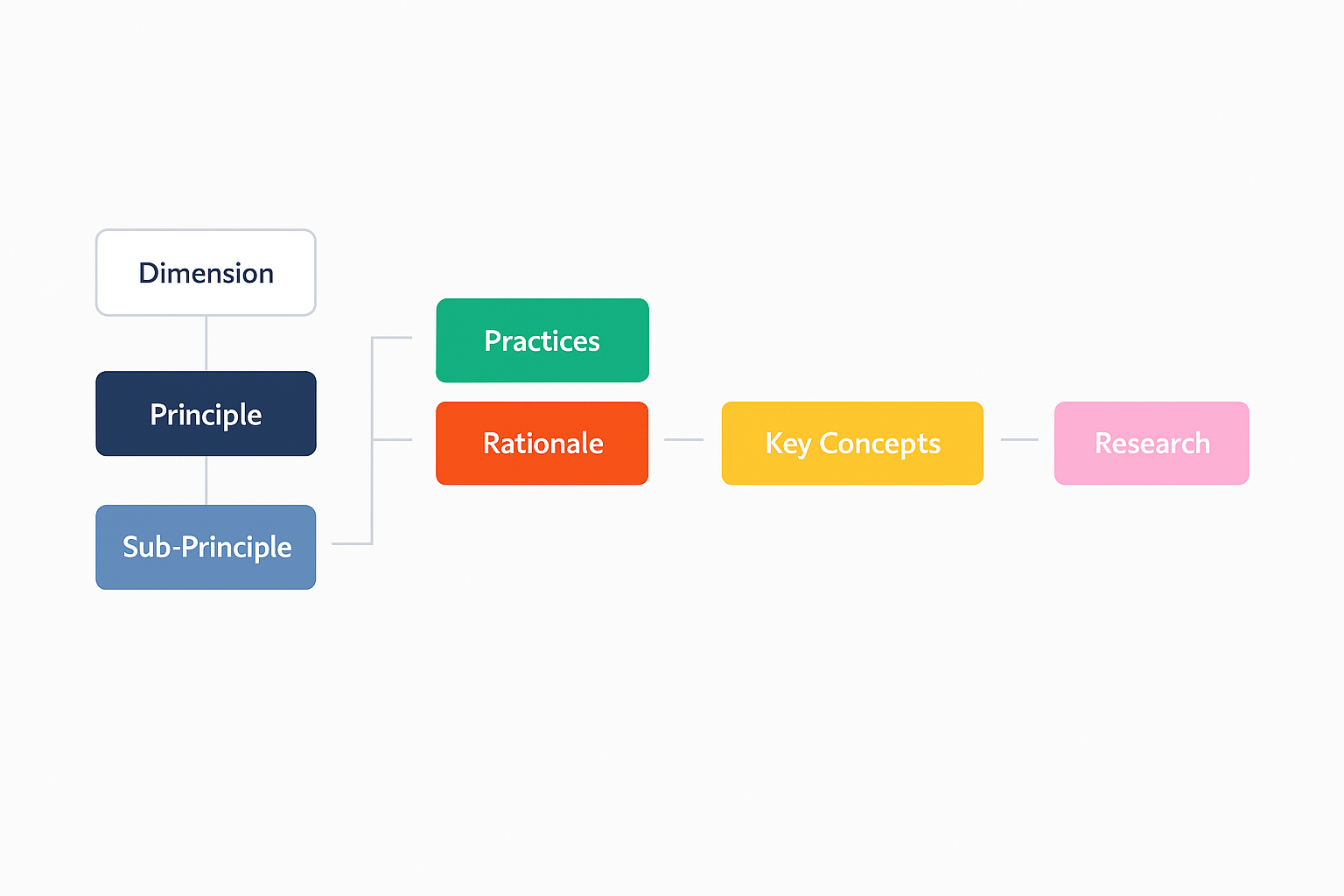
The structure of the OxPoLL framework
Example
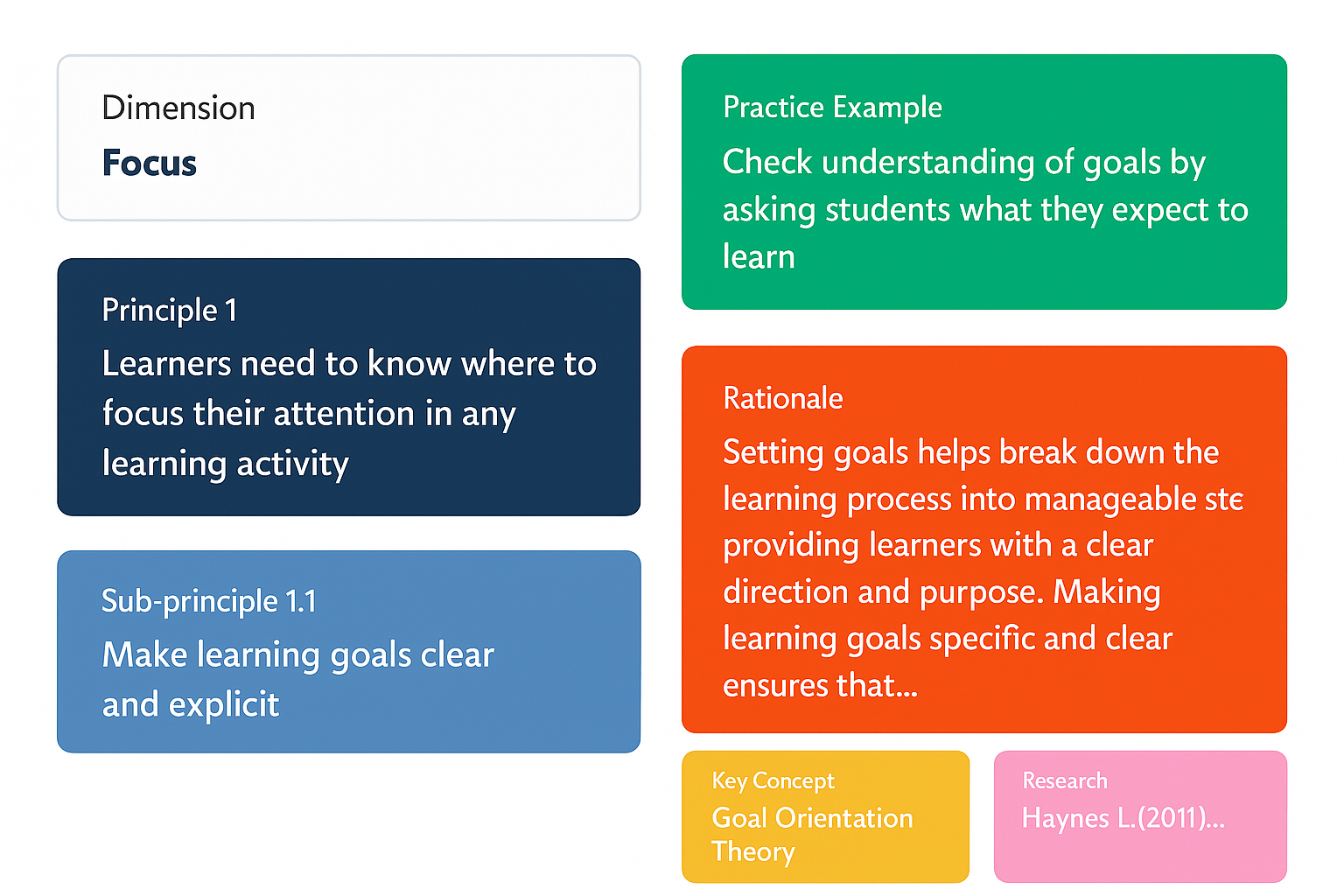
Example of how the framework principles connect to teaching practices
Who is this framework for?
For Classroom Teachers
Draw on principles to inform lesson planning and reference evidence-informed practices when challenges arise in areas like motivation, feedback, or task design.
For School Leaders
Evaluate teaching materials and digital tools, or inform institution-wide pedagogical interventions and professional development.
For AI & EdTech
Provides a critical lens to assess the pedagogical soundness of AI-generated materials and supports thoughtful exploration of new teaching tools.
At Oxford University Press
Underpins the approach of authors, editors and learning designers to ensure all materials are grounded in evidence-based principles.
Framework Components
Ready to explore the principles?
Discover how each of the ten principles can inform and enhance your teaching practice.
View All Principles